
High-converting web design Dubai businesses can trust is not created by translating an English homepage after the design is finished. Arabic and English visitors need the same clear offer, but each language also needs the right reading direction, navigation, search intent, form experience and local proof. If one version feels complete and the other feels like an attachment, the website loses trust before the visitor reaches the contact form.
I build production websites and SaaS products where design, frontend code, performance, accessibility and data handling must work together. My practical rule for a bilingual Dubai website is simple: treat Arabic and English as two complete customer journeys powered by one maintainable system.
This guide explains how I would plan the content, RTL interface, mobile experience, conversion path, technical SEO, accessibility and privacy checks for a Dubai business website in 2026. It does not promise a conversion percentage. The goal is to remove avoidable friction and create a site that can be measured and improved with real visitor data.
Web design Dubai starts with two complete user journeys
A bilingual project should begin with the customer and the task they came to complete. A property buyer, clinic patient, B2B procurement manager and restaurant customer do not need the same information. Before drawing the homepage, identify the top three actions for each audience, such as viewing a service, checking eligibility, requesting a quote or booking a consultation.
Then map those actions in Arabic and English. The structure may stay consistent, but the wording should not be a literal line-by-line translation. Arabic copy often needs a different sentence rhythm and may require a short explanation where an English industry term is commonly used. Product names, locations, prices and legal wording need an approved bilingual glossary so the same term does not change between pages.
Give every language a proper URL
For a serious bilingual site, I normally prefer separate URLs such as /en/services/ and /ar/services/. Each URL can have its own title, description, headings, internal links and share preview. Visitors can switch languages without losing the page they are viewing.
Google also recommends different URLs for language versions instead of changing the same URL through cookies or browser settings. Its multilingual site guidance explains how reciprocal hreflang annotations help Search connect equivalent pages. Keep a visible language switcher as well. Do not force a visitor onto Arabic or English only because of an IP address or browser setting.
<link rel="alternate" hreflang="en-AE" href="https://example.ae/en/services/">
<link rel="alternate" hreflang="ar-AE" href="https://example.ae/ar/services/">
<link rel="alternate" hreflang="x-default" href="https://example.ae/en/services/">
Each language page should normally use a self-referencing canonical URL. Do not canonicalise the Arabic page to English as if Arabic were a duplicate that should disappear.
Build real RTL behaviour, not a mirrored screenshot
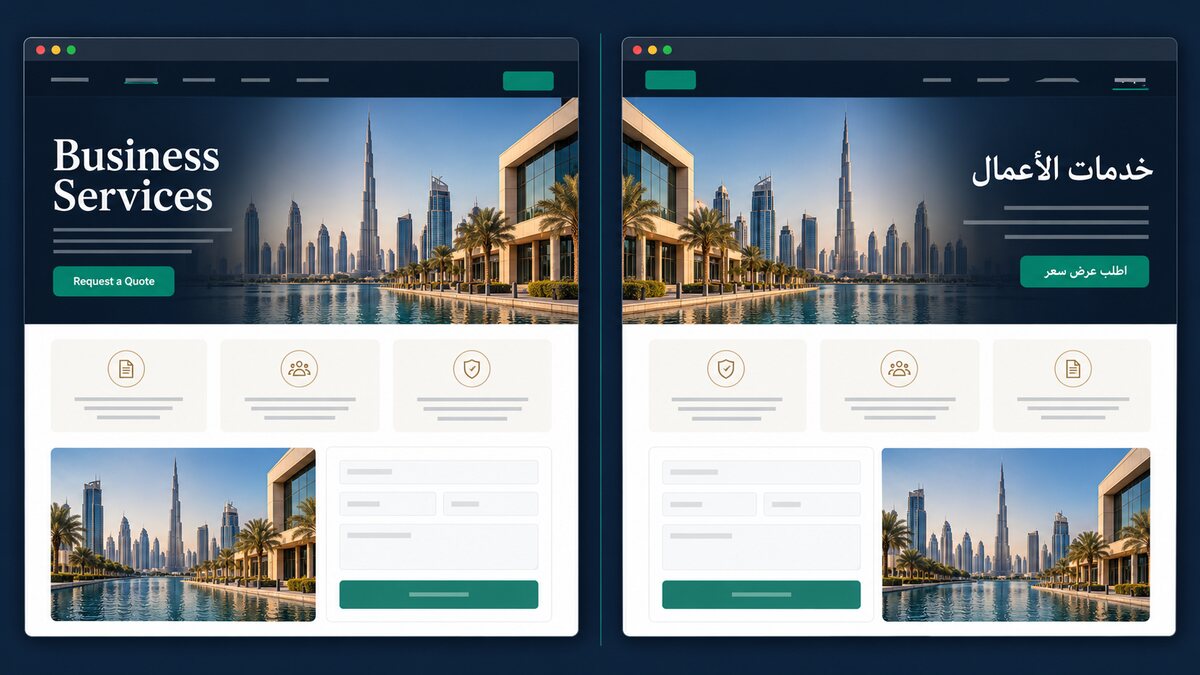
The Arabic document needs lang="ar" and dir="rtl". The W3C's right-to-left HTML guidance recommends setting direction in markup, while CSS logical properties let spacing follow the writing direction.
<html lang="ar" dir="rtl">

.card {
  padding-inline: 1.25rem;
  margin-inline-start: auto;
  text-align: start;
}
Logical properties such as margin-inline-start and padding-inline reduce separate CSS overrides. Still, not everything should be flipped. A company logo, media play icon, clock, phone number, email address and product screenshot may keep their original direction. Mixed Arabic and English values need testing with real content, not only lorem ipsum.
Design the conversion path for mobile visitors
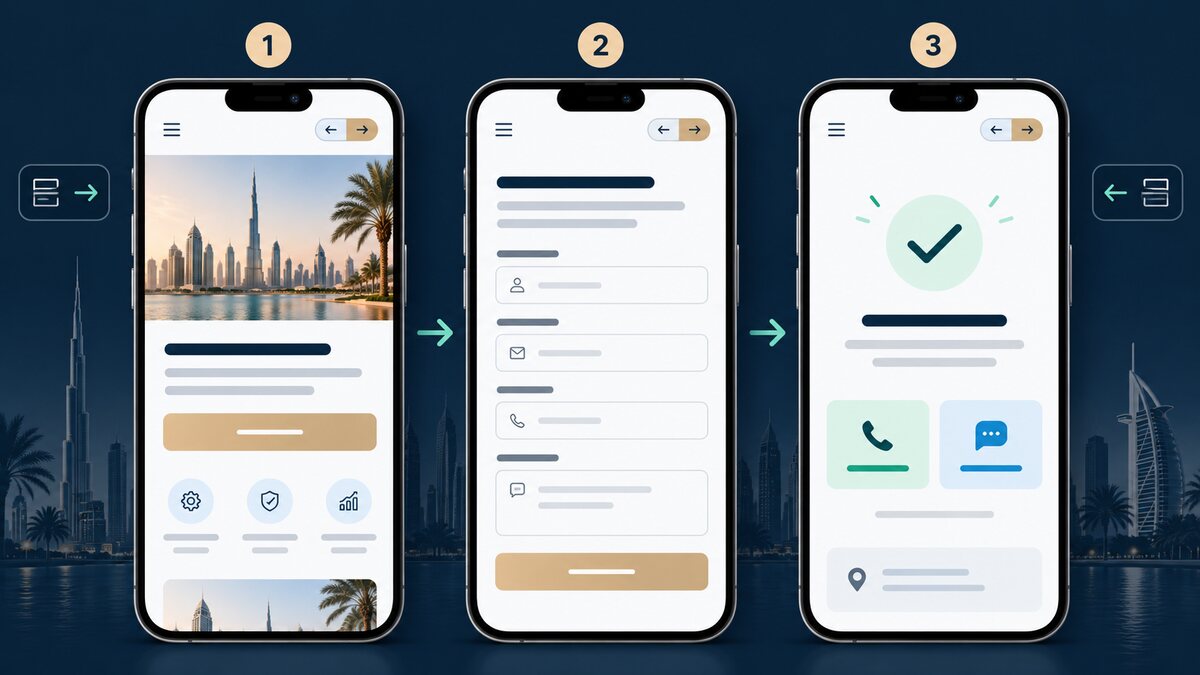
A beautiful hero section does not help if a visitor cannot understand the offer or reach the next step. The first mobile screen should answer four questions: what the business provides, who it is for, why it is credible and what the visitor can do next.
I prefer one primary action per page, supported by a lower-commitment option. A service page may lead with “Request a consultation” and also offer a phone or WhatsApp contact. A product page may lead with “Start a trial” and offer “View a demo.” Both language versions should describe the same commitment. Do not translate a neutral English action into aggressive Arabic sales copy.
Use local proof that helps a decision
Useful trust signals include a real UAE service area, business contact details, clear support hours, relevant project evidence, named technology partners where authorised, and an honest explanation of what happens after a form is submitted. Testimonials should be genuine and attributed with permission. A row of unexplained badges is weaker than one relevant case study that shows the problem, your role and the outcome.
The contact form should ask only for information needed at that stage. For a first enquiry, name, work email, company and a short project note may be enough. Long forms can be split into sensible steps, but progress indicators and error recovery must work in both directions. Keep entered values when validation fails and place the error beside the correct field.
Performance is part of the sales experience
Dubai customers may visit through modern office broadband, a busy mobile connection or an older device. Responsive HTML, compressed images, correctly sized fonts and a small JavaScript budget give all of them a faster path to the content.
Google's mobile-first indexing guidance says the mobile version is used for indexing and ranking. I therefore keep the important content, headings, links, image descriptions and structured data equivalent on mobile and desktop rather than hiding the useful material on smaller screens.
Measure loading, responsiveness and visual stability using the current Core Web Vitals: LCP, INP and CLS. The official Web Vitals guidance recommends evaluating these metrics at the 75th percentile. A score alone does not prove the page converts, but slow rendering, delayed buttons and moving layouts create friction that should be fixed before buying more traffic.
Accessibility and privacy belong in the conversion plan
Accessibility is not separate from conversion. A visitor may use a keyboard, screen reader, zoom, voice control or a mobile device in strong sunlight. Clear headings, visible focus, sufficient contrast, large touch targets, useful labels and understandable error messages make the same journey easier for everyone.
TDRA states that its platforms follow the UAE Design System and WCAG 2.2 AA. That does not automatically make every private business legally subject to the same exact standard, but it is a strong local benchmark for quality. My practical website development Dubai accessibility checklist covers keyboard testing, focus, forms, mobile targets, screen readers and release checks.
Test Arabic accessibility with Arabic content
Run keyboard and screen-reader checks on both languages. Confirm that the page language is announced correctly, focus order follows the visible layout and the language switcher has an understandable name. At 200% zoom, Arabic buttons and headings should wrap without clipping. Form errors need to be connected programmatically to their inputs, not indicated by red colour alone.
Test the journeys that create business value: open the menu, compare services, submit a lead, use search, download a document and recover from a failed form. Automated scanners find useful issues, but they cannot decide whether an Arabic label makes sense or whether the user understands the next step.
Collect less data and explain the reason
A lead form, analytics platform, chat widget and advertising pixel can all process visitor data. The official UAE portal explains that the federal Personal Data Protection Law provides a framework for privacy and restricts processing without consent except in specified circumstances. The exact obligations depend on the organisation, location, sector and processing purpose, so legal advice may still be required.
From a product perspective, disclose what is collected, why it is needed, how long it is kept and which third parties receive it. Do not load optional marketing trackers before the required choice where consent is the basis being used. Protect form endpoints against abuse and send data only over HTTPS.
Businesses comparing IT services Dubai providers should ask who owns the analytics account, where form submissions go, how access is removed and how data requests are handled. Privacy wording and the actual technical behaviour must agree.
Keep the website connected to the wider customer journey
The website may be the first step, not the whole service. Customers may continue through WhatsApp, a CRM, a booking system, a chatbot or a mobile application. Preserve the chosen language and enquiry context when that handoff occurs. Nobody should need to repeat the same details because the website and support system were designed separately.
This is also relevant when planning mobile app development Dubai businesses can extend with bilingual support. Shared terminology, authentication rules, analytics events and privacy controls create a more consistent experience across web, app and conversational channels.
Measure each language separately
Track meaningful actions such as qualified form submissions, booked calls, trial starts, phone taps and WhatsApp conversations. Segment results by language, page type, device and traffic source. A combined conversion rate can hide a broken Arabic form or a slow English landing page.
Before changing a headline, confirm that analytics events fire once and identify the correct language. Review search terms and support questions for missing information. If Arabic visitors repeatedly ask about pricing, eligibility or delivery areas, improve the relevant page instead of adding another generic blog post.
Use a bilingual launch checklist
- Every important English page has a complete Arabic equivalent, and vice versa.
- Language URLs, canonicals,
hreflanglinks and sitemap entries are correct. - Arabic pages use real RTL markup and mixed-direction values display correctly.
- Navigation, forms, validation, search and contact actions work in both languages.
- Mobile pages contain the same useful information as desktop pages.
- Images are compressed and include dimensions and meaningful alt text.
- Keyboard, zoom, contrast, focus and screen-reader checks cover key journeys.
- Analytics and conversion events identify language without double counting.
- Privacy notices match the forms, trackers and integrations actually in use.
- A fluent reviewer approves Arabic meaning, tone and terminology before launch.
Practical takeaway
A high-converting Arabic and English website is not two sets of words inside one visual template. It is one business promise delivered through two complete, tested user journeys. The strongest projects plan language architecture early, build RTL behaviour into the component system, keep mobile pages fast, make forms accessible and measure outcomes separately.
Start with one important service page and one conversion action. Build and test both language versions with real content, then reuse the proven components across the rest of the site. That approach produces a more trustworthy experience than translating dozens of pages after development is finished.
If your Dubai business needs a bilingual website or SaaS product designed around real customer journeys, send me the project details.

Written from production experience