
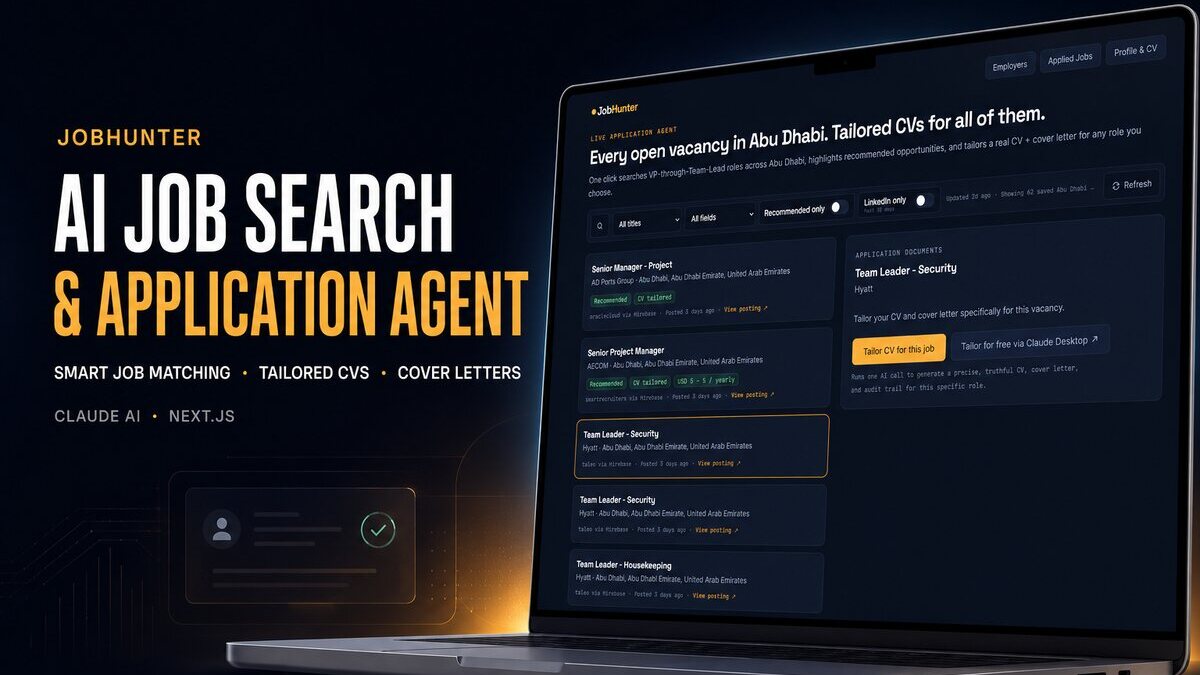
Quick answer: a useful AI job application agent should find relevant roles, compare them with verified employment history, tailor only factual CV content and stop for human approval before anything is submitted. Blind auto-apply is the wrong product boundary.
An AI job application agent should save time without turning a job search into dishonest mass outreach. That is the boundary I keep in mind while building JobHunter, a TypeScript product that brings job discovery and CV tailoring into one workflow. The useful part is not a bot that clicks Apply everywhere. It is a system that finds relevant roles, explains the fit, prepares an evidence-based CV version and leaves the final decision with the candidate.
This guide explains how I would build that AI job application agent as a production product. It covers the data pipeline, scoring, truthful CV tailoring, structured model output, privacy, testing and human approval. The same architecture works whether the job source is an approved API, an email alert, a company careers page or a role pasted directly by the user.
What an AI job application agent should actually do
A job search contains several different tasks, and they should not be hidden inside one vague prompt. Discovery finds possible roles. Extraction turns a messy job description into usable fields. Scoring compares the role with the candidate's real profile. Tailoring reorganises verified experience for that role. Review shows the candidate every important change. Submission, if supported at all, remains a separate and tightly controlled action.
This separation matters because each stage has a different failure mode. Discovery can return an expired role. Extraction can misunderstand a preferred skill as a hard requirement. Scoring can overweight repeated keywords. Tailoring can cross the line from clearer writing into a false claim. A single "find jobs and apply" agent makes those errors difficult to see and almost impossible to test.
I prefer a pipeline where every stage produces an inspectable result. The candidate can see why a role was selected, which requirements matched, which gaps remain and which CV bullets changed. That creates a useful assistant instead of an application spam machine.
Use approved inputs, not brittle scraping
The discovery layer should accept sources the product is allowed to use: official feeds or APIs where available, user-forwarded alerts, saved searches, public company career pages accessed within their rules, and job descriptions pasted by the candidate. Each source needs its own small adapter. The adapter returns a common job record rather than exposing source-specific HTML to the rest of the system.
This design also makes the product more resilient. If a source changes its page, only one adapter needs attention. More importantly, account credentials and browser sessions do not need to be handed to a model. The application retrieves permitted data, validates it and passes only the job content required for analysis.
AI job application agent architecture: keep a typed pipeline
The core data model should be boring and explicit. A normalized job record might contain title, company, location, work mode, seniority, responsibilities, required skills, preferred skills, application URL, source and the time it was collected. Unknown values stay unknown. The extraction step must not fill gaps with a plausible guess.
I use the same principle for the candidate profile. Education, employment dates, project outcomes, technologies, locations and links form a verified fact store. The model may choose and rewrite those facts, but it cannot add a new employer, metric, qualification or tool. Keeping this source separate from generated CV text is the strongest defence against accidental fabrication.
Model responses should be structured data rather than a block of prose that the application later tries to parse. OpenAI's Structured Outputs guidance explains how a JSON Schema can constrain model output to the fields an application expects. In this workflow, that means the UI receives a predictable score, matching evidence, gaps and suggested edits.
type JobAssessment = {
  fitScore: number;
  matchedEvidenceIds: string[];
  missingRequirements: string[];
  cvEdits: Array<{
    sourceFactIds: string[];
    originalText: string;
    proposedText: string;
    reason: string;
  }>;
  needsHumanReview: true;
};
Notice that every proposed edit points back to one or more source facts. The model is not asked to "make the candidate look ideal." It is asked to select relevant evidence, express it clearly and disclose gaps. The server still validates identifiers, score ranges and required fields before saving anything.
Do not let the model control permissions
If the agent can call tools, those tools should be narrow: getCandidateFacts, saveDraftAssessment or renderCvPreview. A generic database tool or unrestricted browser session gives the model more power than the feature needs. OpenAI's function-calling documentation recommends strict schemas for reliable tool arguments, but schema compliance is only the first layer. The server must still authenticate the user, check ownership and enforce which actions are allowed.
The model can propose an action; application code decides whether it can happen. This is especially important for anything external, such as sending a message or submitting an application.
Tailor the CV without inventing experience
Truthful CV tailoring is mostly selection and emphasis. If a backend role asks for Node.js, PostgreSQL and multi-tenant SaaS experience, the tailored version should move the strongest matching work higher, use the employer's terminology where it accurately describes the same skill and remove less relevant detail. It should not claim five years of a framework the candidate used for one project.
I would enforce three rules in code and in the review interface. First, every generated bullet needs supporting fact IDs. Second, protected facts such as employer names, dates, degrees and certifications cannot be altered by free-form generation. Third, numbers must match the source exactly. If the profile contains no verified metric, the agent writes a qualitative result instead of manufacturing a percentage.
The review screen should make these rules visible. Show the original and proposed text side by side. Highlight new wording. Display the supporting evidence and explain why the change helps this application. A candidate should be able to accept one edit, reject another and restore the base CV at any time.
Fit scoring needs the same honesty. A useful score combines required-skill coverage, relevant project evidence, seniority, location or work-mode constraints and important gaps. It should not pretend to predict whether a recruiter will hire someone. The explanation matters more than a number because it lets the user correct a mistaken interpretation.
Keep a person in control of every application
Human approval is not an inconvenience to remove. It is the point where the candidate checks accuracy, tone, salary or location constraints and whether they genuinely want the role. I would keep discovery and draft generation automatic, but make external submission a separate action with a clear confirmation screen.
That screen should show the employer, role, destination URL, selected CV, answers to screening questions and any message that will be sent. It should warn about unanswered or uncertain fields. If a site requires a candidate to confirm information, complete a test or agree to terms, the agent should stop and hand control back.
This approach also prevents duplicate or contradictory applications. Store a durable application record keyed by the candidate, company, role and source URL. Before preparing another draft, check for an existing saved, submitted, rejected or withdrawn record. Retries must be idempotent so a network failure cannot create two submissions.
Protect the candidate's personal data
A CV contains direct identifiers, work history, education, location and sometimes phone numbers or addresses. Collect only what the workflow needs. Keep raw source documents private, encrypt stored data, use short-lived file links and avoid copying full profiles into logs. Access should be scoped to the signed-in user, not only filtered in the interface.
Before selecting any model provider or endpoint, review how prompts, responses and files are retained. OpenAI's current API data controls documentation distinguishes abuse-monitoring logs from application state and documents retention behaviour by endpoint. Product code should deliberately choose storage settings and delete temporary files when the workflow is complete.
Data minimisation also improves model quality. A role assessment rarely needs a home address, phone number or unrelated employment history. Send the relevant fact IDs and text, then let the server assemble the final document from the private profile after the model returns its structured suggestions.
Evaluate the workflow before trusting it
AI output changes with models, prompts and input wording, so manual testing with two attractive examples is not enough. Build an evaluation set from varied job descriptions: clear matches, partial matches, seniority mismatches, remote restrictions, duplicated listings, vague requirements and hostile text embedded in a description.
Measure each stage separately. Extraction tests compare fields with reviewed labels. Scoring tests check whether stronger matches rank above weaker ones and whether hard constraints are respected. Tailoring tests count unsupported claims, altered protected facts and missing evidence links. Review data can track which suggestions candidates accept, edit or reject without treating acceptance as proof that the text is true.
OpenAI's model-selection guidance recommends defining an accuracy target and evaluation dataset before optimising cost and latency. That order is sensible here. First prove that the workflow extracts requirements and preserves facts reliably. Then compare faster or cheaper models against the same test set.
I would also run deterministic tests around the model: ownership checks, duplicate detection, schema validation, missing evidence, document rendering, approval state and failed retries. The language model is one component. Most safety boundaries belong in normal application code where behaviour can be guaranteed.
A practical build order
- Create the verified profile. Store experience, projects, skills and education as reusable facts with stable IDs.
- Normalize one job source. Start with pasted job descriptions or an approved feed before adding more adapters.
- Extract structured requirements. Validate the result and preserve the original description for comparison.
- Add explainable scoring. Return matched evidence and gaps, not only a percentage.
- Generate CV edits. Require evidence IDs and lock protected facts.
- Build the review interface. Show diffs, evidence, warnings and a rendered document before export.
- Add evaluation and monitoring. Test real edge cases, log safe operational metadata and watch for unsupported claims.
- Consider submission last. Keep it source-compliant, explicit, idempotent and human-approved.
This order produces value early. Even without automatic submission, job normalization, explainable fit scoring and trustworthy CV drafts remove repetitive work while keeping the candidate responsible for the application.
Practical takeaway
The best AI job application agent is not the one that applies to the largest number of roles. It is the one that helps a candidate make better decisions and prepare accurate applications faster. Separate discovery, extraction, scoring, tailoring and submission. Ground every CV edit in verified evidence. Use structured output and narrow tools. Protect personal data, test the difficult cases and keep a human approval step before anything leaves the system.
That is the product direction behind JobHunter: useful automation without giving up honesty or control. If you need help designing a focused AI workflow, a Next.js product or a secure SaaS integration, tell me what you are building.

Written from production experience